ABOUT ME
I came from a BBC family. I had a lonely childhood as my father initially worked on BBC transmitters and we were constantly on the move.
For a while we lived with my paternal grandmother in South Wimbledon. There we had an outside lavatory and no bathroom. We had to have stand up washes at the kitchen sink all week, and at the weekends we went to the public baths for a bath.
I was four years old and had lived in 13 different houses by the time my father got a static job in the BBC Test Laboratory in Avenue House, Chiswick. We then settled in Feltham, Middlesex.
When I was seven years old we moved to New Malden, Surrey. We were poor and my mother either made clothes for my younger sister and myself, or she bought secondhand clothes at the weekly jumble sale at the Graham Spicer Institute. This was embarrassing enough, but my humiliation was complete when one year she bought me some pretty summer dresses which turned out to be the summer uniform for the local Ursuline Convent school.
Most of my birthday presents were secondhand, including a Hornby tinplate model railway set with two locos which my father obtained from a work colleague. I'd not had it long before my mother put it out for the dustmen declaring that it was no game for girls. It has been joked subsequently that this is what spurred me on to get myself a big train set!
Cutting short my A Level studies (physics, maths, technical studies and technical drawing), I decided I wanted to be a veterinary nurse. I did this for just over 3 years and worked my way up to Head Nurse in that time. I enjoyed the work, but at the age of 20 I realised I would never be able to support myself on such poor pay, so decided to seek another career.
On a whim I decided I’d like to be a train driver and called the British Rail Southern Region offices in Wimbledon to enquire about applying. The story of my applications and interview can be found in my International Women’s Day 2014 speech (under my then surname of Rutter).
My Early Years
ON THE FOOTPLATE
DRIVER TRAINING
On 6th August 1979 I reported to the Area Depot Manager's Office on Victoria station for my first day on the railway. I was graded as a traction trainee and allocated to Norwood Junction depot. Another traction trainee from the depot, who was only 16 years old and highly embarrassed at the task he'd been given, was sent to collect me and conduct me to the depot.
Arriving at the depot was a shock to the system. It was an all male environment, and as I entered the mess room it fell silent and all eyes were on me. I had with me a large brown paper bag full of the personal equipment I'd been issued with, and I put my head down into the bag and ran through the room to reach the locker room beyond. I was 20 years old and painfully shy and quite naive at that age. Some of the men took pleasure in embarrassing me and frightening me with talk of what would happen to me when I was alone with them on the locos. I quite quickly learned that the ones with the biggest mouths were largely the most harmless...the quiet ones, not always so.
My requests for a uniform were consistently denied with replies that I would likely only get pregnant and leave soon. Before going to the training school for my traction trainee course I did manage to secure a railway dust jacket from somewhere and I wore that to cover my civvy clothes.
The six week traction trainee course was a steep learning curve for me as I had no previous knowledge of the railway at all. At the end of the six weeks I passed my exams and returned to depot, regraded as a driver's relief assistant. I really enjoyed the work: sitting alongside the driver (occasionally having a drive myself) and learning all about the job, pulling points, coupling and uncoupling locos, operating steam heat boilers, helping to observe signals. I was in my element. Late 1979 I was regraded to driver's assistant.
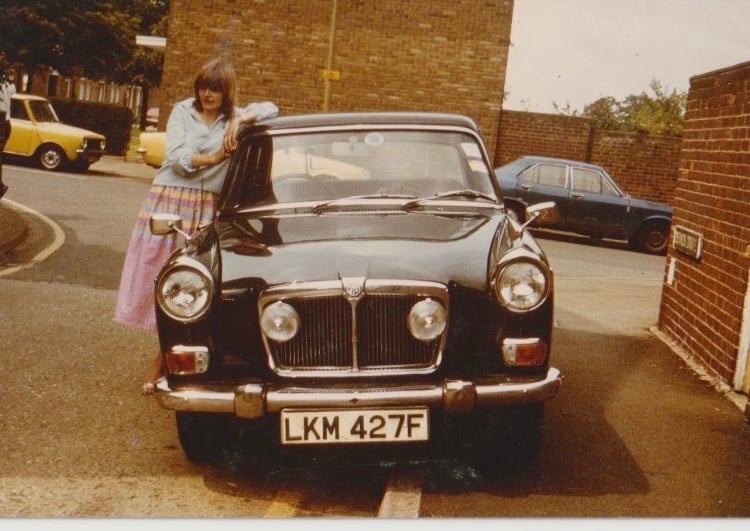
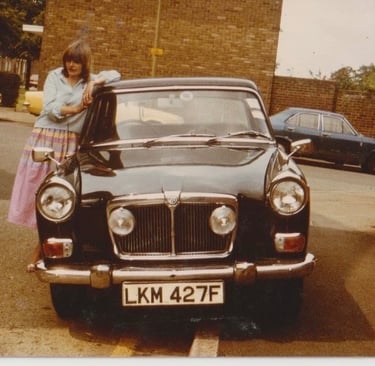
In my spare time I'd started to collect MG Magnette Mk 4 cars - I had three. I joined the Cambridge Oxford Owners' Club (COOC) and became the Surrey Area Secretary. I enjoyed the club activities, including taking my cars to shows. In 1983 one of my cars was on show at Thoroughbred & Classic Car magazine's Classic Car Spectacular show at Knebworth, and appeared in the November 1983 issue of the magazine.
It was necessary to complete 500 secondman/driver assistant duties before being eligible to go to the driver training school for final training. I completed those duties in a comparatively short time, taking any overtime I could get. l adored the job and resented having to take my booked annual leave. Having completed the required number of duties I started to look for a depot with faster progression than Norwood Junction and decided on a move to Waterloo. I transferred there as a driver's assistant on 12th July 1982 and I started my driver training course (MP12) on 9th August 1982. The six month course culminated in an intensive three days of exams, ending on 17th February 1983 when to my disbelief and delight my examiner told me I'd been passed for driving.
MY DRIVING CAREER
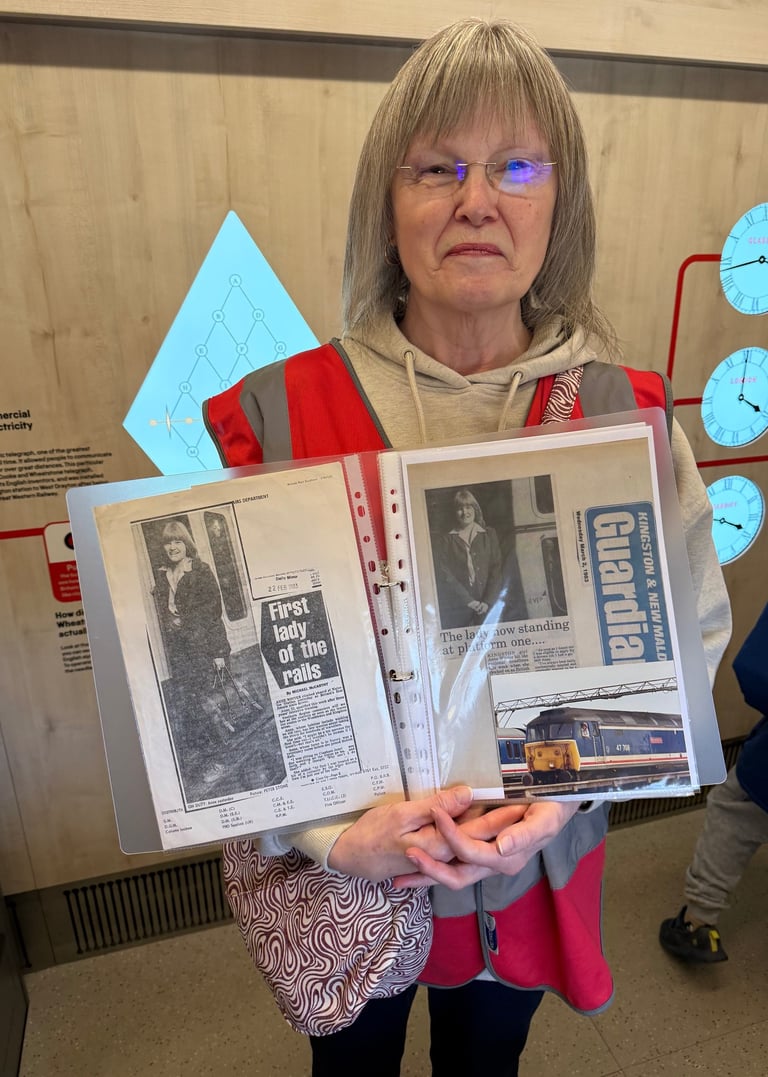
On 22nd February 1983 the British Rail Southern Region Press Office released the news that British Rail had its first qualified woman train driver. They had been following the progress of the women in training for over a year, but still delayed releasing the news for a number of days to give themselves time to check nationwide that there were no other women drivers on the network. Having satisfied themselves that this was the case the news release went ahead and I had a full day of being interviewed and photographed for the press, TV and radio stations. The news obviously went international because in the following weeks I received a number of letters of congratulations from both the UK and abroad, including Ghana, Egypt and India. There were requests for me to appear on TV shows (both light entertainment and documentary) which I politely declined - I was shy and not good to camera. I did however, agree to open a school fete in Oxfordshire and was interviewed for a number of books and magazines.
It was exciting to have made history, and although the positive media attention was acceptable to me for a while, I was more keen to be getting on with my train driving career so largely declined any further requests for interviews.
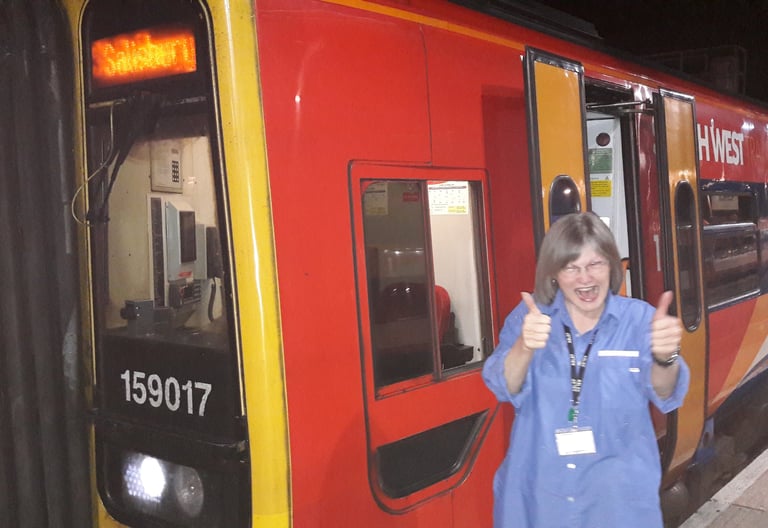
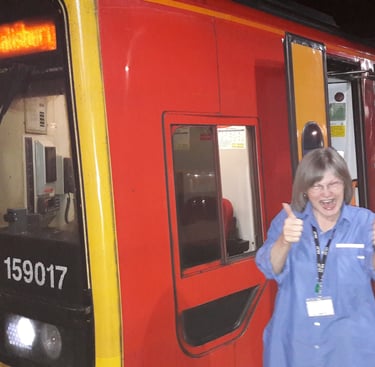
I was based at Waterloo until 1991 when | transferred to Salisbury depot which was a very different and much quieter environment. I was also to be driving locomotives as opposed to the 'juice' trains (electric multiple units) I'd been driving at Waterloo. It wasn't long until Salisbury had a brand new maintenance depot for the new 159 units and over time these took over the bulk of our work. I loved driving 159s and I was lucky enough to drive them right up to my retirement in 2017.
My last drive was very special; the last train to Salisbury from Waterloo on a Sunday night, arriving in Salisbury just after 1am on the Monday morning. On approach to Salisbury the signalman called me on the cab radio and wished me well in retirement. He told me he was signalling in a legend and I'd got my wish - green signals into platform 4 at Salisbury. As I entered the platform he came out of the signal box and saluted me. Despite the late hour I sounded the train horn all the way down the length of the platform. I came to a stand where a group of my colleagues had gathered and I was laughing and crying at the same time. A memory I’ll hold forever.
NEGATIVE EXPERIENCES
ASLEF
In 1979 when I joined the railway it was a ‘closed shop' and I was recruited in to ASLEF soon after my arrival at Norwood. It had no impact on me one way or the other until 1982, when I was asked by a couple of other secondmen if I would go with them to a union meeting one evening to vote against planned strike action. I was shocked that those of us who voted against the strike were intimidated until we changed our vote. By way of protest I decided to go in to work and I gave my pay for those days to charity. I was unable to do anything productive as I wasn't a driver and I was only booked two days work before I started my annual leave. This unfortunately followed me through my railway career, and it gave the misogynists amongst my colleagues the perfect peg on which to hang their hatred. I was pleased when the Trade Union Act 1984 was passed requiring the use of secret ballots from September 26th that year, and in all future actions I was happy to abide by the genuine majority vote.
In February 2007 a man threw himself under the wheels of my train and I suffered PTSD as a result. The treatment I received from my managers at the time was woefully lacking and I wrote a letter to the ASLEF Journal telling of my experience. I received a letter from the then General Secretary, Keith Norman, congratulating me on it being the Star Letter for that issue.
In 2011 I was alerted by a newspaper article to the news that Derby Works (where the units I drove at the time had been built) was under threat after not being granted the contract to build the Thameslink trains. Instead the government had awarded the contract to Siemens in Germany. I made contact with the office running the campaign in Derby and was sent petition forms, and I set about getting signatures. I decided I wanted to start raising awareness of this locally, and with the blessing of the then branch secretary at Salisbury, I printed off posters and hundreds of leaflets and distributed them at work and through letter boxes locally. Aware that a large protest march was planned in Derby on 23rd July that year I sought help from other branches, through our branch, but only managed to get one person activated enough to attend. Consequently I wrote this letter which was published in the ASLEF Journal of September 2011. The first line of my original letter 'Where were you on 23rd July 2011?' was omitted by the editor.
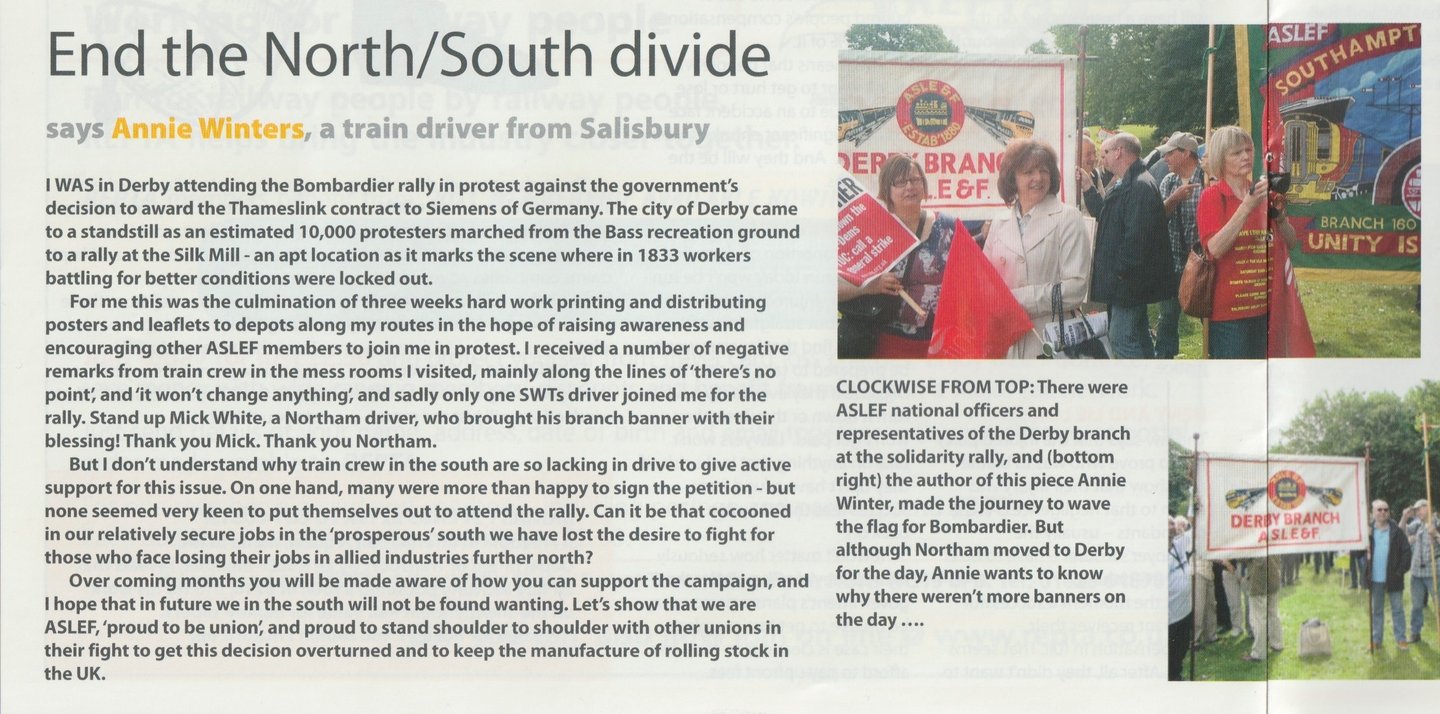
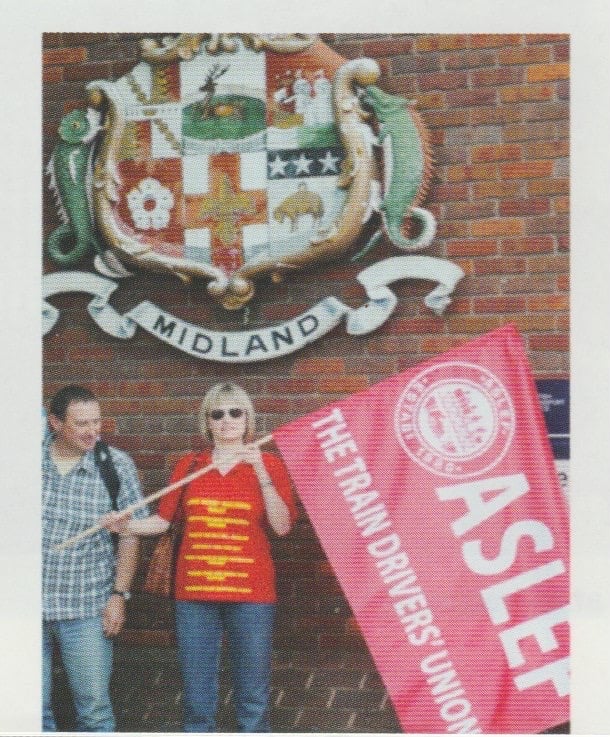
Subsequent to my activity in this campaign, I was voted in as Salisbury ASLEF Branch Secretary at the end of 2011 when the current branch secretary resigned. It was an honour, and I loved the work. I held the post for three years before stepping down in April 2015.
In 2014 I was invited to speak at an International Women’s Day event in London. I was injured following a fall and was unable to attend but another ASLEF woman went in my place to read my speech. She later told me it had been very well received.
MISOGYNY & BULLYING
I approached each work day with caution (and sometimes anxiety), never being sure what unpleasantness I would encounter each shift. There was name calling and things were written in the cabs, which I became used to, but a few particularly nasty incidents stood out:
Soon after I passed for driving I was walking across a busy Waterloo station concourse when a group of drivers kettled me to a point where I came face to face with a particularly spiteful young driver who refused to let me pass. He spat out the words “We don’t want you here. You make the job look easy “, after which the group melted away across the concourse.
One Christmas Eve when I was on a late shift and had to take my car into work, I finished my shift and on returning to my car found that every single tyre had been let down. I was alone in a quiet, isolated area and had no means of pumping up my tyres. This was in the days before mobile phones. With nobody around to help me I had to seek police assistance but this took some time. Thankfully they were able to pump up my tyres and stayed with me until I was safely on my way home. It was a long drive home to the village on Salisbury Plain where I lived at that time, and I arrived very late at night and feeling quite upset. The incident cast a cloud over my Christmas.
On another occasion I was driving a train to Dorking when I had problems with my brakes. It was subsequently found that my brakes had been tampered with.
I’m grateful that during my career I also worked with some kind and supportive drivers who helped keep my spirits up and who sometimes even challenged the bullies on my behalf. My move to Salisbury depot in late 1991 improved this situation considerably, and although I still encountered pockets of this behaviour, I at last had days when I could really relax and enjoy my work.
CORRECTING HISTORICAL ACCURACY
CORRECTING A COMMON MYTH
In the late 1990s the BBC approached me to ask if I’d appear in a documentary programme they were making called Peoples Century. As a factual piece of television I was interested, but I cautioned them that I ‘wasn’t good to camera’. I heard no more, but when the programme aired I was shocked to see that they’d featured Karen Harrison (who’d qualified years after me), and that no mention was made of the fact that I had been the first female driver on the British Rail network. The following day I contacted the BBC and spoke to a member of the production staff, who apologised that I had not been listed on the programme as the first woman train driver on British Rail, and I was told that my details would be added to the BBC reference library so that this mistake would not be made again. Unfortunately the implications made in this programme were enough to sow the seeds of historical inaccuracy, which were strengthened further via other subsequent appearances Karen made, as she welcomed more publicity whilst at the same time I avoided it. A Wikipedia page (since amended/corrected) set up for Karen also helped the misconception to spread.
In 2025 I was alerted to the fact that during a TV programme hosted by Michael Portillo on the 200 years of the railway, a locomotive had been named after Karen Harrison and she was inaccurately named on the programme as ‘Britain’s first woman train driver’. I was shocked and decided that I needed to address this widely accepted inaccuracy once and for all.
THE PIONEERS: THE FACTS
Over a two year period in the late 1970s the railway had it’s first female trainees to the footplate grade. The first of these in early 1978 with Jacqueline Abberley at Cricklewood depot, and the last was Karen Harrison at Old Oak Common, who joined in November 1979. The date of joining the ‘line of promotion’ to driving was called the seniority date. Seniority was very important in the grade.
Seniority dates:
In chronological order:
Jacqueline Abberley at Cricklewood depot in early 1978.
Celine Rocchia at Ripple Lane depot: 30th April 1979
Sandra Baldwin at Brighton depot: 6th June 1979
Tina Whybrow at Hither Green depot : 11th June 1979
Anne Winter at Norwood Junction: 6th August 1979
Patricia Roche at Kings Cross depot: 29th October 1979
Karen Harrison at Old Oak Common: 12th November 1979
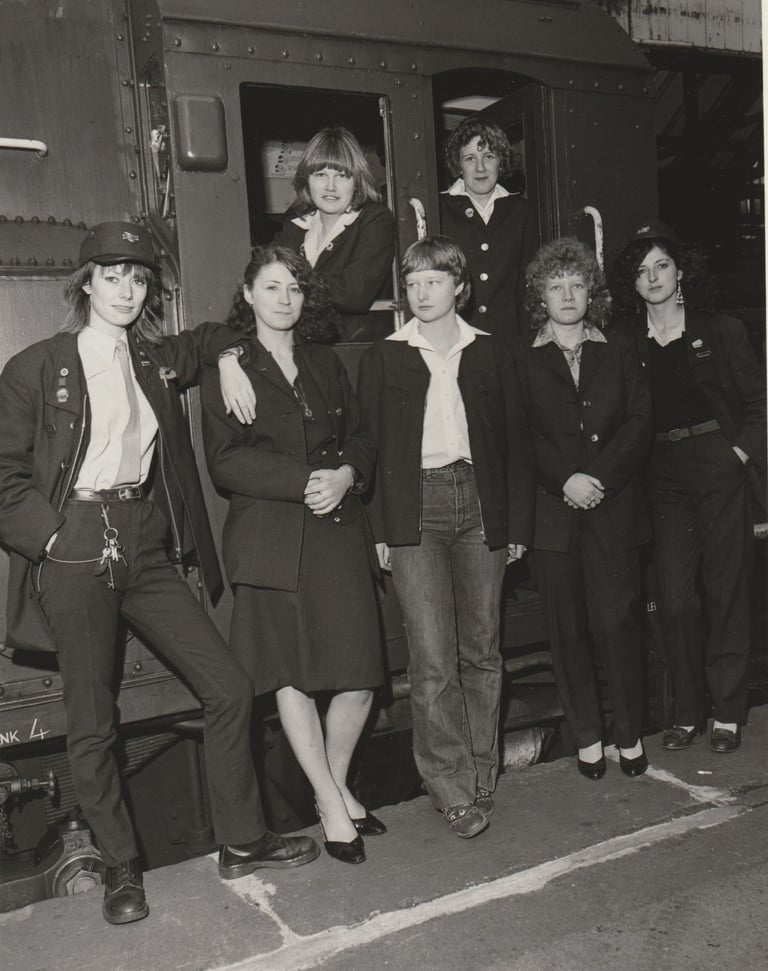
Photo of the 1979 entrants (I am in the driving seat. Additionally in the photo is Sarah Wainwright (Hither Green) 1980/81: centre front.
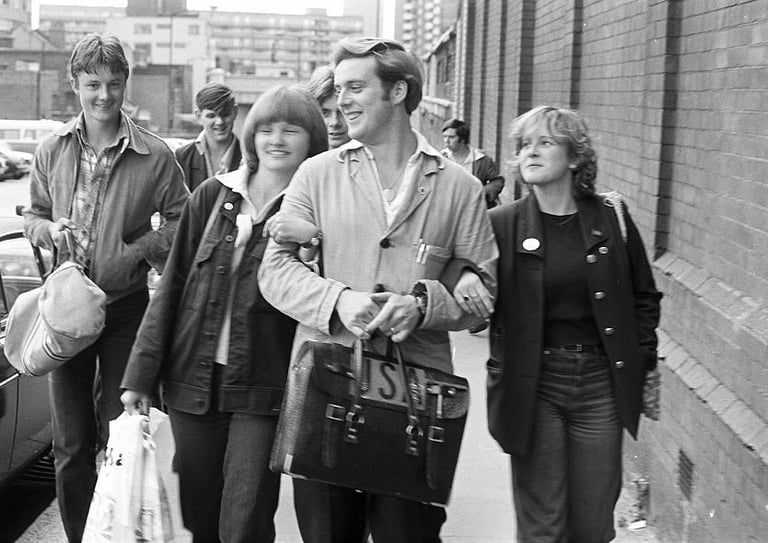
Tina Whybrow and I were together on our initial training (Traction Trainee) course at South Side Training School, Waterloo. (Photo courtesy of Colin J Marsden)
Dates passed the driving exam:
Anne Winter (Waterloo) 17th February 1983
Celine Rocchia (Victoria) April 1983
Karen Harrison (Selhurst) late 1985/1986
Tina Flint (née Whybrow) (Slade Green) 1986
Patricia Roche - no information
Jacqueline Abberley and Sandra Baldwin (and Sarah Wainwright) left the job without passing for driving.
Appointment dates in order:
Relief Driver Celine Rocchia (Streatham Hill) May 1984
Driver’s Assistant Karen Harrison (Selhurst) March 1985
Driver’s Assistant Tina Flint (née Whybrow) (Slade Green) September 1985
Relief Driver Anne Ross (née Winter) (Waterloo) March 1987
Relief Driver Patricia Roche (Marylebone) May 1988
The information above, where dates are given, is based on British Rail Promotion, Transfer and Redundancy sheets.
An explanation of the British Rail Line of Employment 1968 to 1988 can be found here:
TODAY
WHAT I AM DOING NOW
I retired on 15th June 2017, just weeks short of 38 years in the footplate grade. I can truthfully say after leaving the railway I didn't ever look back. It was simply the right time to go.
In retirement I moved from Salisbury to nearby Warminster for a few years. Then I decided to move to a coastal town in the West Country (my happy place). I keep busy with seeing friends, attending craft groups, walking on the beach and I volunteer at the local museum and on a local restoration project.
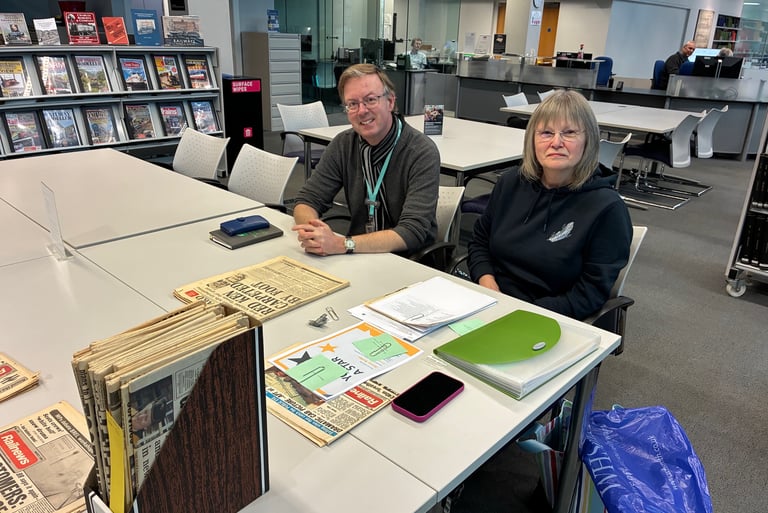
In February 2026 I made contact with the National Railway Museum to do some research on the pioneering women drivers and to take some of my own personal archive material to show them. I had interesting meetings with Dr Oliver Betts (Research Lead) and Anthony Coulls (Senior Curator of Rail Transport and Technology). Both expressed the desire for me to build an ongoing relationship with the museum.
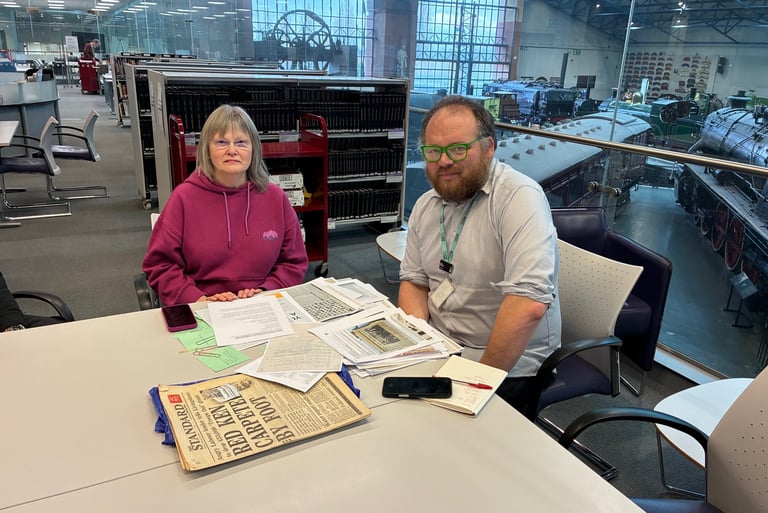
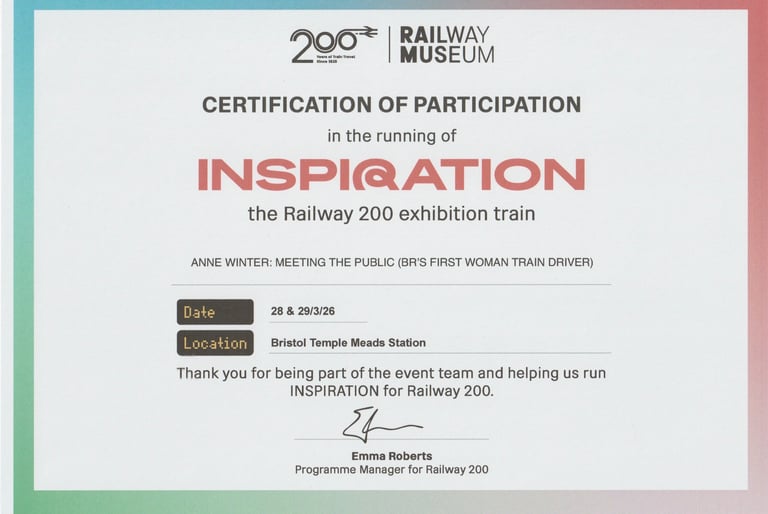
In March 2026 I was invited to join a VIP Railway 200 event on Salisbury station where the Inspiration train was blessed by the Dean of Salisbury. Following this I was also invited to meet the public on the same train when it was on display at Bristol Temple Meads station.
FUN & INTERESTING STUFF
On the 22nd March 1983 The Sun newspaper had a small piece entitled "Loco lass prangs tot's steam train', telling how I had been driving a miniature steam train at an Oxfordshire school fete I’d opened, when the loco became derailed. Thankfully this was found not to be my fault.
In April 1983 I had an appointment at my local TSB bank in New Malden to apply for a bank loan to pay for the renovation of one of my cars. Unfortunately for me my appointment coincided with a bank raid, and as I was sitting in the bank manager's office the door was thrown open and a sawn off double-barrelled shotgun was aimed at the manager and myself. We were ushered out of the office at gunpoint into a narrow passageway where I went into a dead faint. I regained consciousness later lying on the floor of the back office where the staff had returned to work as if nothing had happened. I was taken home by the police and later that afternoon the bank manager visited with a big bunch of flowers to apologise for the experience l'd had. He told me "you can take it you've got your loan!”. The following week a small piece on the bank raid appeared in The Kingston Informer newspaper and my part in the event was reported thus: "A young woman customer in her early 20's who had been in the manager's office when the thieves broke in was taken home by police to recover from the ordeal”.
On Saturday 20th June 2009, the Sun newspaper's The Big Crossword had a clue "She was 23 when she became Britain’s first woman train driver in 1983 (4,6). The following week the correct solution of “Anne Winter" was given.
REFERENCES
Newspapers
Magazines
Books
Further information can be found on the britishnewspaperarchive.co.uk website.
CONTACT ME
In the main I have included information on where to find the references rather than direct links, due to copyright issues. For anyone doing research into a relevant area who would like access to my extensive personal archive, which contains hard copies of most of the items mentioned and a great deal of additional information and items of interest, please feel free to contact me via the attached form.
CREDITS
With thanks to the following...
Andrea Aslett
Tony Aloszko
Nick Elton
Helena Wojtczak BSc, FRHistS
Colin J Marsden
Tom Lawford - website developer/designer